


Artificial Intelligence (AI) is now a catalyst for achieving personal, business, and global Sustainable Development Goals (SDGs). Whether you’re working toward better productivity, clean energy, education, or climate resilience, AI provides data-driven clarity, automation, and long-term sustainability.
Here’s how to harness AI responsibly and effectively
Clarify and Align Your Goals with AI-Driven Insights
Before action comes clarity. Many goals fail because they’re vague or misaligned with actual needs.
AI helps you define, refine, and align your ambitions with measurable impact.
How:
- Use ChatGPT, Notion AI, or Perplexity to convert abstract aspirations (“I want to grow my business”) into SMART, SDG-aligned goals (“I want to increase local employment by 20% in 6 months while maintaining fair wages”).
- Combine AI survey tools like Typeform with OpenAI analytics or Microsoft Copilot to analyze your strengths, weaknesses, and current resource usage.
- Employ AI-powered decision support (e.g., Anthropic Claude for ethical evaluation) to ensure your objectives align with sustainability principles.
✅ Result: Data-backed goals grounded in real-world needs, not emotion or guesswork.
Automate Repetitive Processes to Maintain Consistency
Sustainability thrives on consistency. AI keeps your daily operations running smoothly so you can focus on creativity and strategy.
How:
- Use Zapier, Make (Integromat), or n8n to connect tools and automate administrative, financial, or social media tasks.
- Schedule and prioritize work using Motion, Reclaim.ai, or Google Gemini Workspace for time-blocking and intelligent reminders.
- Implement AI-driven customer and workflow management systems like HubSpot AI or ClickUp Brain to maintain steady engagement.
✅ Result: Continuous progress with less burnout and more focus on high-impact tasks.
Use Predictive Analytics to Anticipate and Adapt
AI doesn’t just show you what’s happening, it can forecast what’s next. Predictive analytics helps you stay ahead of risks and make smarter choices.
How:
- Apply Google Cloud AI Forecasting or Power BI Copilot to predict market, climate, or performance trends.
- Use AI budgeting platforms (like Cleo, YNAB AI, or PocketGuard) to model future financial outcomes and ensure responsible resource management.
- Leverage AI health and productivity trackers (Fitbit AI Insights, Apple Health ML, or Oura Ring) to anticipate burnout or health dips before they derail progress.
✅ Result: You act proactively, adjusting your strategy before obstacles escalate.
Personalize Continuous Learning and Capacity Building
True sustainability depends on learning and adaptation. AI enables customized education and self-improvement for individuals and teams.
How:
- Learn new skills through AI tutors and adaptive platforms like Khanmigo, Duolingo Max AI, or ChatGPT Learning Mode.
- Refine your communication, writing, or coding with GrammarlyGO, Jasper, or GitHub Copilot.
- Use AI-driven personal development dashboards (Strides, Reclaim, or Notion AI) to track your growth and recommend next steps.
✅ Result: You evolve intelligently and continuously without always needing external consultants.
Measure Impact and Optimize for Long-Term Sustainability
AI’s most powerful contribution is impact measurement — turning raw data into insights that help you sustain growth and reduce harm.
How:
- Use AI sustainability platforms (like IBM Envizi, Microsoft Cloud for Sustainability, or ClimateAI) to track your environmental footprint, energy usage, or supply chain emissions.
- Employ data dashboards (like Power BI Copilot or Tableau GPT) to visualize trends across productivity, finance, and resource efficiency.
- Generate automatic monthly sustainability or performance reports with ChatGPT Advanced Data Analysis or Excel Copilot.
✅ Result: Continuous optimization — your impact is measurable, scalable, and sustainable.
Shift Your Mindset: Treat AI as a Partner, Not a Shortcut
AI is a co-pilot, not a crutch. Sustainable success happens when human vision meets machine precision.
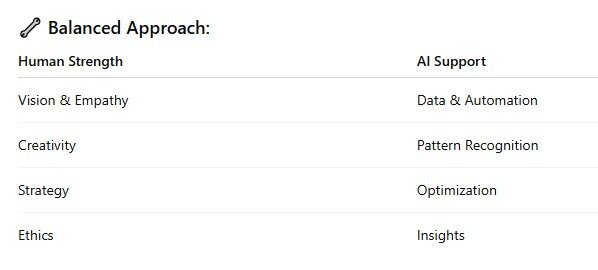
Example Workflow (for Sustainable Business Growth):
- Plan: Use ChatGPT or Perplexity to co-create a mission-aligned business plan.
- Execute: Automate marketing using Jasper, Copy.ai, or HubSpot AI.
- Manage: Track milestones in Notion AI or ClickUp Brain.
- Analyze: Use Google Analytics AI or Power BI Copilot to refine campaigns.
- Reflect: Revisit ChatGPT to evaluate results and forecast next steps.
✅ Result: You achieve your goals faster, ethically, and sustainably — blending innovation with human values.
The Bigger Picture: AI for the UN Sustainable Development Goals
AI directly supports global SDGs such as:
- Zero Hunger (SDG 2): Smart agriculture and food waste monitoring.
- Quality Education (SDG 4): Personalized learning and inclusive education tools.
- Affordable & Clean Energy (SDG 7): AI optimization for renewable grids.
- Climate Action (SDG 13): Predictive climate modeling and carbon tracking.
- Decent Work & Economic Growth (SDG 8): AI-powered workforce development.
When applied ethically and transparently, AI becomes the bridge between vision and sustainable impact.